


Inefficient or under-calculated airflow can quickly become your production’s worst nightmare.
When your system doesn’t deliver enough air, your tools and air compressor will both take a hit. Tools may slow down, lose power, and even stop working altogether. Meanwhile, your air compressor experiences unnecessary strain, increased wear and tear, and a higher risk of overheating. On the other hand, oversizing your compressed air components can impact you with unnecessary costs; initial upfront equipment costs, energy expenses, maintenance costs, etc.
Cubic feet per minute (CFM) measures the volume of air moving through your system. When it’s not at an optimal level, it can cause major performance issues. That’s why knowing the CFM of your system is essential.
We’ll explain how to determine the optimal CFM for your compressor, how to choose the correct system size, and common mistakes to avoid when picking out a compressed air system.
What is CFM in a Compressed Air System?
Pneumatic tools need two things to work properly: enough airflow and the right pressure.
CFM (Cubic Feet per Minute) measures the volume of air a compressor can deliver, or a tool can consume in one minute. In other words, it tells you how much air is moving through the system.
CFM is measured at the compressor’s output pressure, the point where compressed air leaves the compressor and travels through the hose to your tool.
Pounds per square inch (PSI) measures the force of the air. It’s the pressure required to operate certain tools effectively. The force is what gives compressed air its energy to perform the work.
CFM and PSI work hand in hand. Both must be supplied effectively for an air tool to perform as intended. CFM (volume of air) determines the speed at which equipment can perform its task and pressure (PSI) provides the energy (force) to accomplish its task.
If your air compressor doesn’t provide enough CFM for your tools, they won’t run smoothly, or they won’t run at all, and eventually this mismatch can shorten the lifespan of the tool, as well as the compressor.
How to Determine the Right CFM for Your Air Compressor
Air volume needs vary greatly from tool to tool. Think of the difference it would take to run a small tool versus an industrial system. Oversizing or under sizing the CFM can negatively affect the performance and efficiency of your equipment.
These steps will help you determine the correct CFM:
- Determine the number of tools the compressor will power.
- Figure out the CFM requirement of each tool.
- Decide whether the compressor will power one tool at a time or multiple tools.
- If it will power one tool at a time, figure out the tool with the highest CFM requirement, then multiply it by a safety factor of 1.5.
- If the compressor will power multiple tools at a time, add up the CFM of each tool, then multiply by the safety factor of 1.5.
- Calculate the cost per CFM in the compressed air system. Generally speaking, the cost per CFM is about $0.25 per 1,000 ft.3, based on $0.08/kWh. You’ll have a better understanding of your production’s needs. Find the exact cost per CFM with an easy formula that shows how much usable air volume your system provides.
CFM in Action: Why it Matters in an Air Dryer
CFM is a main factor for selecting the correct size compressed air dryer. Why? It indicates whether the dryer can handle the volume of air flowing through the system.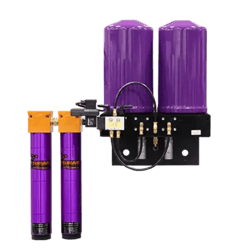
The CFM of the air dryer must match or exceed the air compressor’s CFM output. This ensures effective moisture removal from the air. An air dryer with a CFM that’s too low won’t be able to dry the air properly, and it can even contribute to equipment failure.
Operating with optimal CFM is the cost-effective best practice. It saves energy, reducing the total cost of ownership.
Common Mistakes in CFM
CFM plays a vital role in choosing compressed air systems. Make sure to avoid these common mistakes when making your choice:
- Under sizing: A CFM that’s too low leads to inadequate performance, and your system will struggle to meet production demands.
- Oversizing: While the system will be able to meet the demands, you’ll be wasting energy and money.

- Ignoring environmental factors: Always consider the surrounding environment throughout the whole year. Factor in humidity, temperature, and possible contaminants in the air. This will impact the demand on your air compressor system and makes a compressed air dryer a shop necessity.
- Ignoring future expansion: If expansion is even a possibility for your business, it’s worth factoring into your plans. Failing to plan for a larger facility will make your air compressor system undersized sooner than expected.
- Pressure: Understanding the pressure requirements of your equipment will help you make effective decisions in selecting compressor size and dryer size.
The Right Compressed Air CFM Makes All the Difference
CFM is the volume of airflow a system can produce or use in 1 minute, while PSI is the force of airflow. Matching your compressed air system with the correct CFM is essential to keep your production cost-efficient by eliminating unnecessary equipment failure and wasted energy.
Your workspace deserves the benefits of the right air compressor and dryer. Ensure you’re running at maximum efficiency by contacting Tsunami to help determine the optimal CFM for your production.
