
Compressed air is often referred to as the “fourth utility” in manufacturing behind electricity, water, and gas. Just like those are key sources of energy, air is a source of reliability, efficiency, and flexibility.
As automation continues to expand, the need for pneumatic power systems will continue to grow. It plays a critical role in delivering performance, precision, and productivity across robotics, conveyor systems, CNC cutting, and metrology inspection equipment.
Read below to gain a better understanding of how compressed air makes lives easier in these various industries through automation.
How Does Compressed Air Benefit the Automation Industry?
Compressed air enhances the automation industry by being a clean, safe, and dependable power source. It helps companies make products faster and more accurately. It’s especially helpful for operations involving robots, assembly lines, processing, and packaging machines due to its precise, repeatable motions.
Additional core benefits of compressed air systems include:
- Energy-efficient and cost-effective: Although the initial setup may be expensive, compressed air systems can lower energy costs, especially when using an effective CFM (cubic feet per minute). One central system can power many different machines.
- Reliable performance: Provide consistent force output free of human error.
- Rapid actuation: Allows for fast and precise movements, which is important for high-speed manufacturing, packaging, and sorting.
- Safe for hazardous or sensitive environments: There’s no risk for sparks or toxic leaks, making them ideal for environments with heat, dust, flammable materials, or strict cleanliness standards.
- Easy to scale up or change: Systems can easily be adapted, expanded, or modified to meet evolving production demands.
- Simple to install or upgrade: Pneumatic components allow for straightforward integration into the existing machine.
- Reduced downtime: Air-powered tools are durable and require less maintenance if the compressed air system has proper filtration and drying.
Industry Snapshot: Compressed Air in Automation
| Role | Key Benefits | Industry Examples | |
| Robotics | Powers the precise movement of robotic arms and end-of-arm tools (gripping, lifting, clamping) | Fast, precise motion with consistent force; safe operation in high-speed production lines; easy integration into automated cells | Pneumatic grippers used in pick-and-place robots |
| Conveyor Systems | Operates actuators, diverters, stops, and sorting mechanisms that move products along lines | Reliable, repeatable movement; quick response times; low maintenance; scalable | Pneumatic conveyors use pressure to transport products from point A to point B |
| CNC Cutting | Supports tool changes, material clamping, cooling systems, and debris removal | Steady, consistent force; clean operation; improved precision; reduced downtime | High-pressure nozzles clear metal shavings from the cutting area |
| Metrology Inspection Equipment | Controls precise positioning systems and part handling for measurement and quality checks | Smooth, controlled motion; contamination-free power; repeatability for accurate measurements | Robotics arms powered by air actuator sensors that scan complex geometries on a product line |
Compressed Air in Robotics
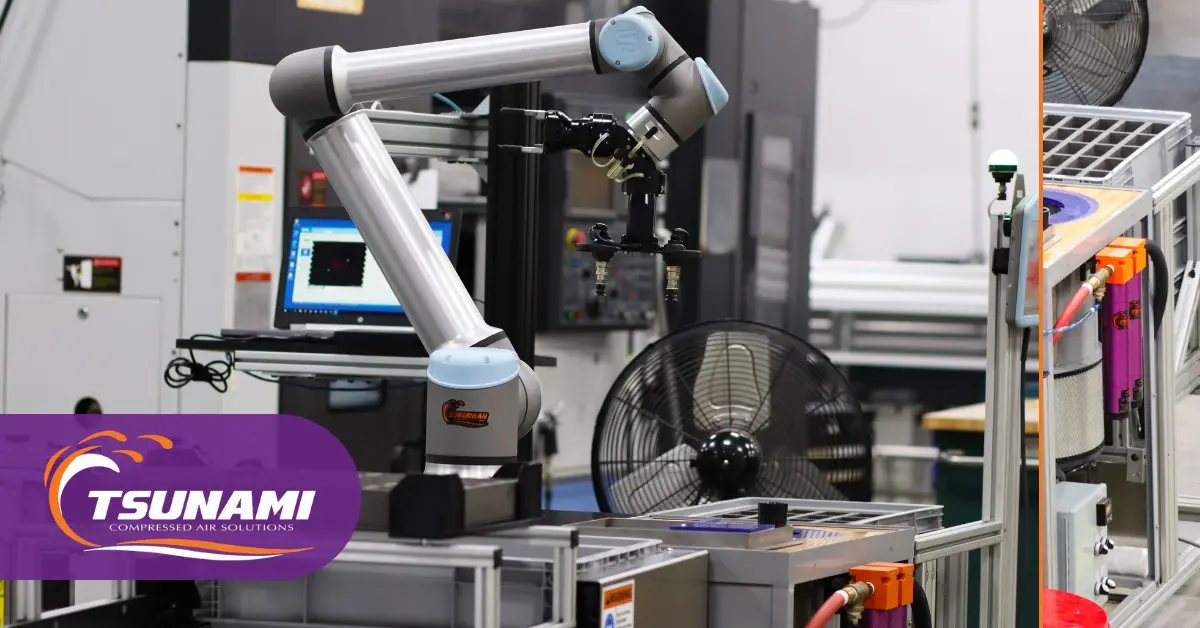
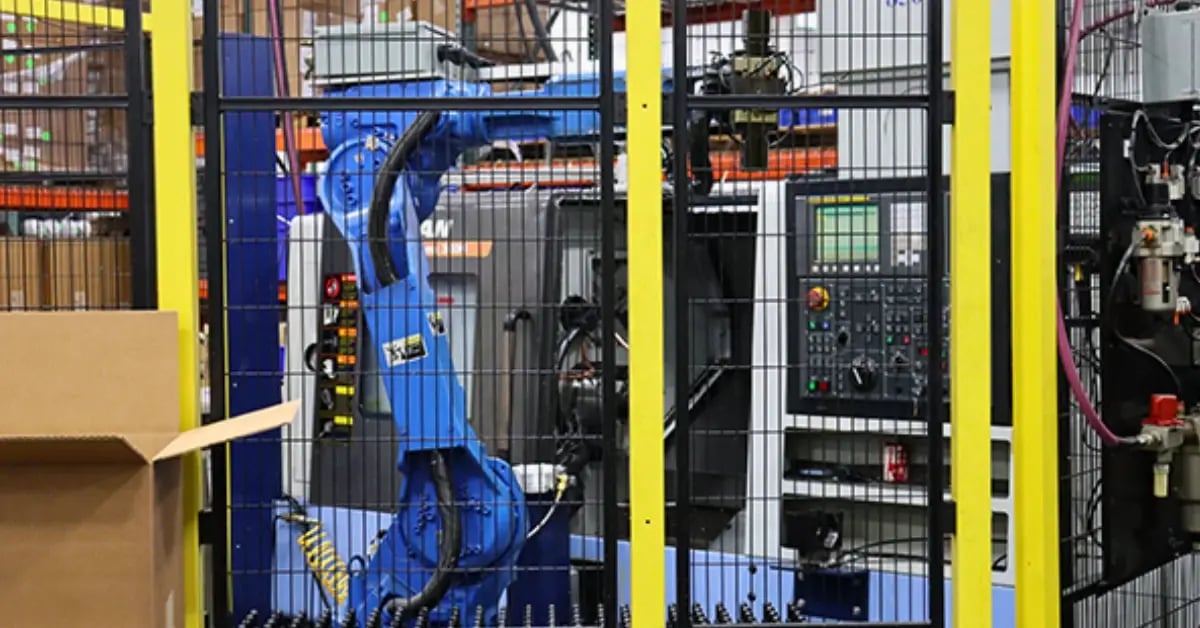
Pneumatic automation helps robots open and close grippers, clamp items, and move components back and forth with quick, controlled motion. It can also help speed up tool changes, allowing one robot to switch attachments and handle multiple jobs. One of the biggest uses of compressed air in robotics is pick-and-place, where it creates suction that lets robots lift and move items, for packaging and material handling.
Using compressed air in automation offers many performance advantages. The cycles are faster, allowing robots to finish more products in the same amount of time. Pneumatic components are often lightweight, which allows robots to move faster and more efficiently. Combining robotics and pneumatic automation delivers more repeatable and consistent results, reducing mistakes and increasing volume.
Common examples of robots using pneumatic automation include:
- Assembly lines: picking and placing parts, tightening screws, and clamping pieces in place
- Packaging: Moving products into trays or boxes, sealing, and sorting
- Electronics: Handling small, sensitive parts carefully and consistently
Compressed Air in Conveyor and Material Handling
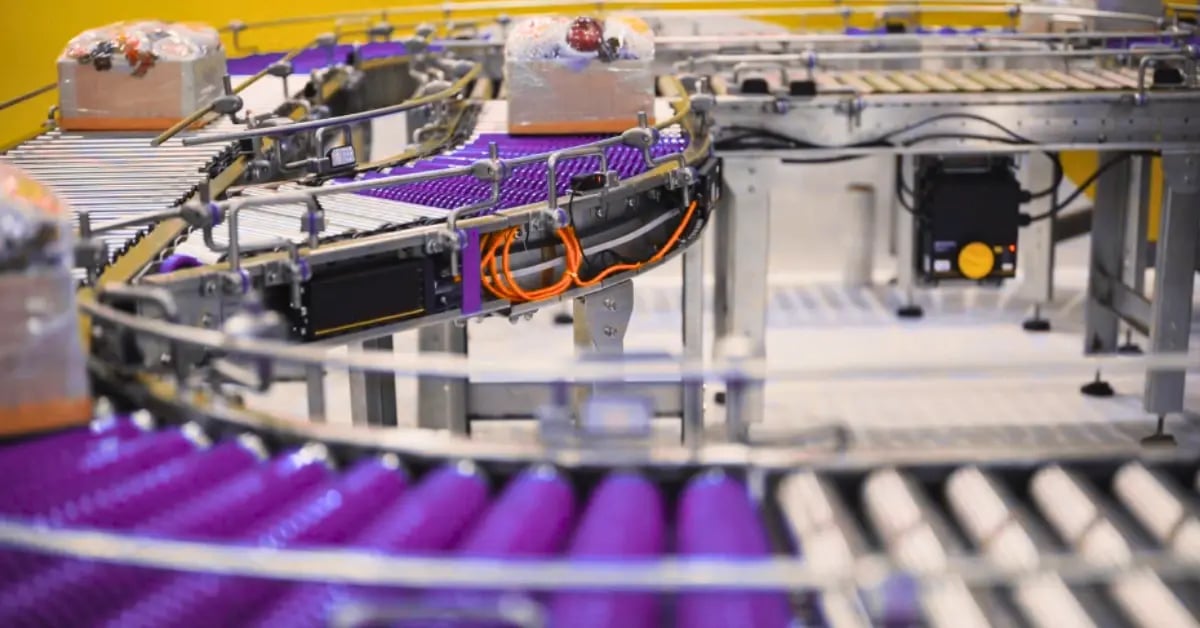
Compressed air helps control the traffic flow on a conveyor line. Pneumatic actuators automate gates, stop products when needed, or line up products automatically. Air-powered diverters can push products into different conveyor lines for routing, sorting, and merging lines. Compressed air also helps prevent jams by spreading products out or briefly pausing them so the line keeps moving smoothly.
Pneumatic automation offers many advantages in conveyor systems. It provides smooth, consistent movement for stable product flow. This system can make quick adjustments for precise timing and synchronization. Because it uses air as the power source, it’s well-suited for nonstop operation. It can also simplify system design by reducing the need for complicated mechanics like extra gears and motors for basic functions.
From an operational standpoint, this can lead to higher throughput and more efficient production. With fewer parts, there’s typically less maintenance and less downtime. Conveyor lines also become more flexible, easier to adjust for new products, different sizes, or layout changes.
Compressed Air in CNC and Cutting Automation
Compressed air serves as a vital tool in automated factories. It gives CNC, or laser and plasma cutting machines, the push, speed, and control they need to perform well. It’s also suited for blowing away debris, assisting the cut, and holding parts steady. Compressed air also provides tool cooling, so the parts don’t overheat, as well as part stabilization so the parts don’t shift and runs stay consistent.
The value compressed air brings to automation in CNC and cutting is unmatched. Compressed air adds precision and consistency that results in tight tolerances and uniform cuts on complex designs. Automating material handling and cutting keeps production moving with less downtime and can support 24/7 operation. Air-assisted cooling and cleaning help parts stay stable and align better during assembly, while also reducing debris buildup to extend tool life.
This results in cleaner and more consistent cuts, fewer mistakes, and lower operating costs.
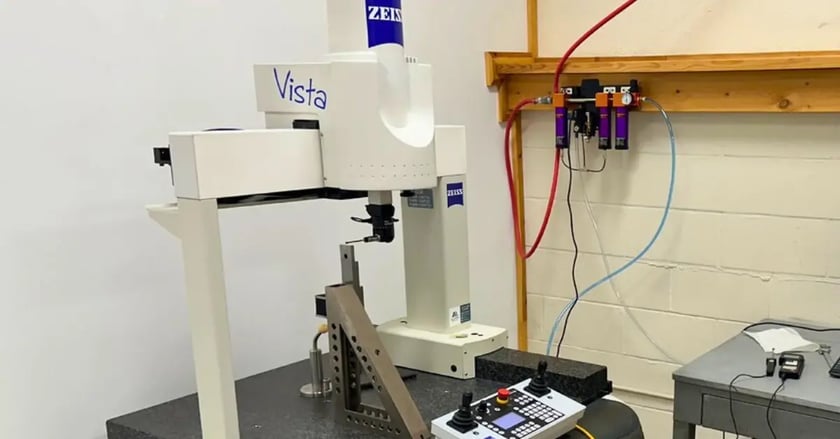
Compressed Air in Automated Inspection and Metrology
Compressed air supports automated quality control in several important ways. Air bearings create a thin cushion of air that allows components to glide smoothly without physical contact. Because there’s no friction, there’s no buildup, which helps maintain ultra-precise positioning and long-term accuracy.
They can also position components for probing or measurement with repeatable accuracy, even in high-speed production environments. Automated air cleaning removes dust, particles, or debris before inspection. Clean surfaces are essential for accurate readings and help reduce false rejects caused by contamination.
Using compressed air in automated inspection systems offers several performance advantages, such as vibration-free movement, higher throughput, and non-contact handling. These advantages make compressed air ideal for industries and applications with strict quality standards, like aerospace and medical devices.
Compressed Air: A Foundation of Modern Automation
Across robotics, conveyor systems, CNC cutting, and precision inspection, compressed air continues to have strategic value in the automation industry. It delivers the force, speed, and precision that modern manufacturing needs, while supporting cleaner operations, smoother workflows, and more adaptable production lines.
Ready to strengthen your compressed air system?
